- VOL 1
- 2026
- research article
Abstract
This paper reviews the literature on gender inequality in the academic field of economics, highlighting both the unequal progress that women have experienced and the persistent barriers that they continue to face. Our analysis of this recent research and available data highlights that the reduction in women’s absence in the field has been heterogeneous. While women now constitute 26% of published economists, their presence sharply declines at higher ranks, with only 5% representation among economists in the top percentile of research influence. Notably, recent progress has paradoxically concentrated at this highest level, indicating shifting institutional norms and evolving perceptions about women’s contributions. We further explore how understanding women’s behaviors and career choices, and gender biases in evaluation and workplace environments, contribute to women’s underrepresentation in the field. Our discussion extends to the labor market for economists, drawing parallels with broader labor trends and examining how gender-biased treatment and hiring processes affect women’s advancement. Finally, we turn to policy interventions that are key in promoting gender balance, focusing on networks, mentorship, role models, and representation.
Introduction
In economics, progress in gender equality has followed an uneven path, with striking contrasts across different career stages. While women have made significant gains in some areas, persistent inequalities remain deeply entrenched. Women now represent 26% of published economists, and yet their presence remains disproportionately clustered at lower career stages. Only 5% of economists in the top percentile of research influence are women, reflecting substantial barriers to women’s careers in that field (RePEc, 2022). Paradoxically, recent progress has been greatest at this top end: Over the past decade, the share of female economists in the top 1% of the field has increased by 108% between 2012 and 2022, while in the next 49%, the share increased by only 8% (RePEc, 2022).
This paradox highlights two key dynamics. First, as Card, DellaVigna, Funk, and Iriberri (2022) point out, there appears to be a growing “positive premium” for women economists in achieving high recognition, particularly in top-tier roles (p. 1937). Yet this comes with a persistent lack of progress at earlier stages (Lundberg & Stearns, 2019), a dynamic that leaves gender inequality in economics largely unresolved. These contrasting trends raise critical questions about the structures and mechanisms that shape gender imbalances in economics. Understanding these inequalities is crucial not only for the careers of individual economists but also for the field itself. The underrepresentation of women in economics has far-reaching consequences. The discipline risks overlooking key insights when it fails to include a diverse range of voices, and gender inequalities may distort the types of questions that economists choose to pursue.
The literature has identified several key barriers facing women in economics. Behavioral differences, such as less willingness to self-promote, self-censorship in competitive environments, and weaker strategic networks, are shown to influence career outcomes. At the same time, institutional biases reinforce these patterns: Women face higher publishing standards, more frequent interruptions in academic seminars, and lower recognition for coauthored work. Recent work has further highlighted that women economists disproportionately experience hostile workplace environments, adding another layer of difficulty to their progression.
Despite this growing body of research, analysis is skewed with much of the existing evidence drawing heavily from U.S. data, limiting insights into cross-country differences and global trends. In addition, while certain mechanisms driving inequality, such as evaluation standards and networking disparities, have been explored, limited understanding remains about how these dynamics interact and evolve over time.
We argue that understanding these patterns requires moving beyond simplified metaphors such as the “leaky pipeline.” While this framework captures the attrition of women throughout the academic career path, it does not fully explain why recent progress is concentrated at the top. Instead, our analysis emphasizes the role of shifting institutional norms, changing perceptions of women’s contributions, and increasing awareness of gender bias in economics. Our inquiry draws from various data sources to provide novel insights on trends from the past 50 years and thematically analyzes the recent findings in the literature. By offering this integrated perspective, we aim to provide new insights for future research and policy interventions designed to foster a more equitable field.
We first provide original evidence on the extent of gender imbalances in economics across time, space, and academic rankings. To do so, we use Research Papers in Economics (RePEc) data (1973–2023), the American Economic Association (AEA) Committee on the Status of Women in the Economics Profession (CSWEP) data (1973–2023), and web-scraped data on journal editors (2023). This data provides two telling facts. First, we show that women are persistently underrepresented all across the economic field, and even more at the top: They represent only 5% of the top percentile of RePEc author rankings, compared to 26% for the 21st–50th percentile, at the lowest rankings that we can observe in our data. Rather than a uniform attrition process, our findings suggest a cumulative pattern of exclusion that produces a steep pyramid in the distribution of women economists—one that begins with an unequal base and narrows sharply with increasing seniority and prestige. Second, while progress may be stalling for female economists at the beginning of the pipeline, gains are being made at the top of the pyramid. Concentrating on the last 10 years of our sample (2012–2022), women economists’ presence increased by 108% in the top 1% of researchers, but the 21st–50th percentile shows negligible gains of only 2%.
Next, we delve into the mechanisms identified in the economic literature that contribute to the lower representation of women in the field. Recent studies have shed light on the barriers that women face in pursuing academic careers in economics. Other literature reviews have analyzed gender inequality in the labor market in general and the consequences of gender as a social structure. We draw from these works when needed, but our main focus remains the economics discipline.
Existing research highlights three key factors contributing to gender disparities in economics. First, gendered behavioral differences shape women’s academic careers, including distinct approaches to balancing work and family responsibilities, greater self-censorship around career opportunities, and coauthor networks. Second, the academic environment treats women differently from men: Women face higher standards in publishing, presenting, and teaching, often receive less recognition for comparable work, and are more likely to experience hostility or discrimination. Third, labor market structures intersect with gender norms to produce unequal outcomes for women economists. Recent work also considers policy tools—such as mentoring, networks, and representation—aimed at addressing these imbalances.
Other reviews of the literature on women in economics are worth noting. In particular, Lundberg and Stearns (2019) describe progress across time made by women in economics in the United States (U.S.). Boustan and Langan (2019) provide evidence on what U.S. economics departments characteristics make more women students succeed, and Buckles (2019) reviews policies implemented at each stage of the pipeline to prevent women from leaving. The contributions of this paper are threefold. First, the latter studies focus exclusively on U.S. institutions while providing statistical evidence. We complement these papers by adopting a more global focus on gender imbalances, and with this, we further bring new quantitative evidence to look at distributional changes in the pipeline of economists. We show that progress over time in women’s presence was unequally distributed and substantial variation between countries and along status exists. Second, we offer new quantitative evidence based on multiple data sources. This broader scope allows us to explore patterns of inequality across regions and career stages, highlighting the structural dynamics that hinder women’s progress. Third, we complement existing reviews by discussing mechanisms playing at the individual, institutional, and field levels on women’s presence, measures of productivity, and recognition. We provide a thematic literature review showing substantial evidence for three key mechanisms of barriers to women: behavioral differences, discrimination, and job market function. In addition, given the rapid expansion of the literature—with over 70% of the works cited in this review published since 2019—this serves as an up-to-date overview of current evidence and debates in the field.
The rest of the paper proceeds as follows. Section 2 describes gender inequalities in economics over several dimensions of the field. Section 3 discusses behavioral differences between men and women that lead to different career outcomes. Section 4 discusses evidence of women being treated differently from men by the profession. Section 5 presents features of the labor market for economists and how they might perpetuate imbalances between the genders. Section 6 presents policy recommendations from the economic literature. A final section concludes the discussion.
Missing Women: Descriptive Evidence
In this section, we provide an overview of women’s presence in economics, drawing from recent studies and data highlighting the gender disparities at each stage of the academic and professional pipeline. We also describe other dimensions of the missing presence of women, such as change over time, geographic disparities, and top institutions in the field.
Combining Existing Studies: Margins of Women’s Presence
Globally, women represent 26% of published economists (RePEc, 2022). Several papers have attempted to measure the unequal presence of women at various stages of the profession: Table A1 in the appendix lists those studies, and we represent their results in a structured manner in Figure 1. Combining these results allows us to compare women’s presence at different stages of the economics pipeline across three countries: France, the United States, and the United Kingdom.
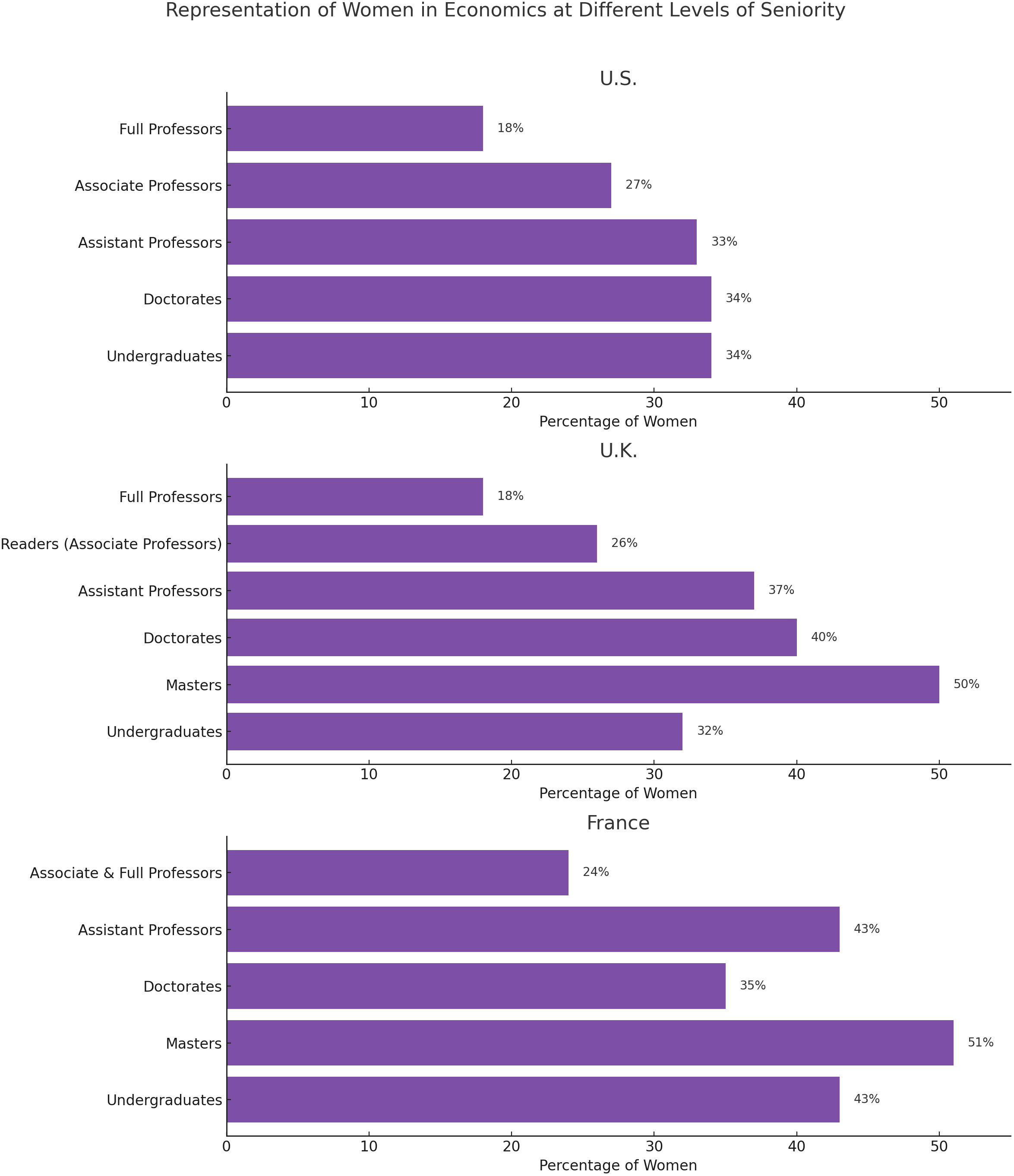
Figure 1. Share of women along the pipeline in the United States, the United Kingdom, and France. In each panel, the bars (in purple) represent the average share of women observed by degree or position type.
Notes: Authors’ own calculations.
Sources: For France: Boring and Zignago (2018) and Sagot (2023); for the United States: CSWEP (2021) and Wessel (2021); for the United Kingdom: Costa-Dias et al. (2023). For more details, see Table A-1 in the Appendix.
Share of women along the pipeline in the United States, the United Kingdom, and France. In each panel, the bars (in purple) represent the average share of women observed by degree or position type.
The leaky pipeline metaphor illustrates how women gradually become more underrepresented in economics, as they disappear at each stage of the curriculum and careers in the field. The effect of the leaky pipelines of generations, carrying the flows of female economists at each career stage, can be represented in cross section with population pyramids, representing the resultant stock of female economists. Figure 1 shows that this presence changes along the pipeline but differs across countries at the same seniority level. From undergraduate studies to full professorship, the data consistently reveals a lower representation of women compared to parity. This representation is increasingly skewed further, with fewer women present as seniority increases. The pyramid shows a broad base of junior female economists but relatively few high-ranking female economists.
At the beginning of the pipeline, undergraduate studies is a time of specialization for students accessing higher education. A priori, students pursuing an economics major constitute the pool of potential future economists. In the United States and the United Kingdom, women represent a third of students with an economics major, reflecting that women tend to already underspecialize in this field and the gender gap in economics starts early (Allgood, Walstad, & Siegfried, 2015). In France, this number is slightly higher, which can be explained by the fact that economics undergraduate degrees are often combined curricula with business and management. In comparison, looking at all disciplines, in 2019, 54% of students awarded a bachelor’s degree in 2019 were women (Bothwell et al., 2022). Progressing along the pipeline, we observe that the United Kingdom and France reach parity for master’s students in economics. Several factors could explain this reversed pattern. First, it is not necessary to have majored in economics during undergraduate studies to enter a master’s degree program in economics. Second, it could be the result of international mobility in the United Kingdom: The total number of women economists at the master’s level are 50% of students, but this number drops to 31% compared to UK nationals (Bateman, Gamage, Hengel, & Liu, 2021). Finally, master’s degrees might constitute alternative training for women wishing to pursue careers as economists who are reluctant to undertake a PhD program. A deeper understanding of this trade-off would be of interest.
We turn to the next step of studies in economics: PhD programs. In the United States and France, women represent around one-third of PhD students in economics, and the percentage is 40% in the United Kingdom. Comparing numbers with the undergraduate level, it appears that the leaky pipeline is taking place at different points in France compared to the United Kingdom and the United States: Fewer women choose to pursue economics studies at the undergraduate level in the Anglo-American system, while women tend to disappear at the doctorate level in France. In the United Kingdom, the last 10 years have witnessed no improvement in female representation at these graduate-level programs (Costa-Dias, Hengel, Jones, & Neves, 2023).
We turn to the stages of the academic career. Women are underrepresented in both junior and senior academic positions, but their presence decreases with seniority. For example, in the United States, women represent only 27% of associate professors and 18% of full professors, contrasting with 33% at the assistant professor level. In the United Kingdom, women constitute around 18% of all professors. France displays a larger presence of women, at 43% of assistant professors and 24% of full professors in 2016. The contrast between 43% assistant professors in France and 35% PhD students can be rationalized by the specific institutional context: Assistant professor positions are usually long-term, civil servant contracts, and yet promotion rates are lower for women than for men, such that the population of women at these lower-level positions is larger due to a glass ceiling effect. Worldwide, a survey of 238 top economic departments and business schools showed that women held a quarter of senior-level positions—whether full professor or associate professor—and just over a third of positions at the junior level (Auriol, Friebel, Weinberger, & Wilhelm, 2022). These numbers indicate that women economists are getting stuck at the beginning of the pipeline, reaching full professor positions at a lower rate than men. Ginther, Kahn, and Milakhina (2025) describe higher barriers to promotion for female economists in economics departments relative to noneconomics departments. This pattern is based on the institutions and individual characteristics.Kleemans and Thornton (2023) find that women are 18% less likely to be promoted to full professor.
Outside options for academic careers matter for the career choices of women economists, as prospects for advancement appear more favorable. In contrast to these academic trends, women have more successfully secured prominent positions in major policy-oriented economics organizations. For example, from 2018 to 2022, the World Bank’s chief economist position was held by two women, and women have held leadership roles at the International Monetary Fund (IMF) and the Organisation for Economic Co-operation and Development (OECD). A broader analysis reveals that women occupy 32% of chief economist roles in international institutions (Formella et al., 2020), which is significantly higher than the 18% of women in full professor roles in academic economics as of 2022. Chassonnery-Zaïgouche, Cherrier, and Singleton (2025) suggest that women’s progress in economics was more rapid in nonacademic sectors than in academia. Contrasting existing studies with more data on women’s presence in nonacademic careers would help understanding where the pipeline leaks to.
Changes over Time: Progress Made at the Top?
Women’s presence in economics has improved over time, but not at the same rate everywhere in the profession. We gather global data to evidence long-term progress (1973–2022) and medium-term progress (2012–2022) in gender inequality. We use data from two sources: RePEc and CSWEP in the United States.
Using RePEc data, which spans from 1973 to 2022, Figure 2a charts the presence of women in economics worldwide through author rankings, a measure of influence over the field. RePEc does not provide a measure of seniority but instead includes a measure of authors’ rankings that we use as a close proxy for it. Rankings are quantified by the combined depth of research impact, measured by the number of citations, and its breadth of research impact, measured by the number of abstract views and downloads. This data reveals that out of 63,833 registered economists, 16,660 are women, constituting a 26% share. The distribution across publication rankings shows a stark inequality: Women represent only about 5% of authors in the top percentile (around 31 women out of 640 total) but 26% in the 21st–50th percentile (around 5,000 women out of 19,000). However, there has been a notable shift between 2012 and 2022, with twice as many female economists in the top percentile, although the overall change remains modest. In contrast, the CSWEP data focuses only on the United States, but it has the advantage of being disaggregated by seniority level. Since 1972, CSWEP has surveyed 250 economics departments annually. Figure 2b plots women’s shares, showing a similar trend of women’s underrepresentation increasing with seniority.
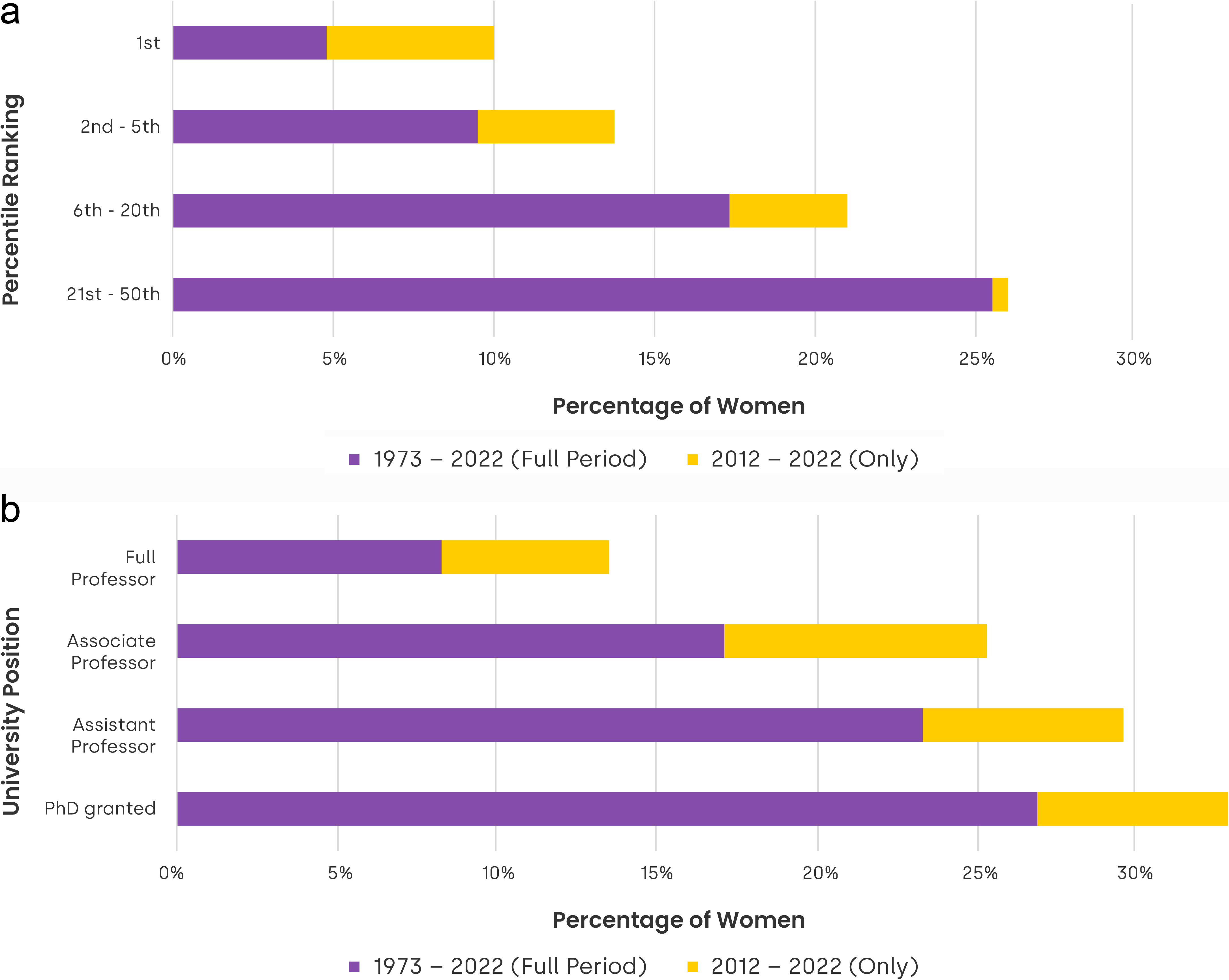
Figure 2. Evolution of the share of women over time by publication ranking and seniority level. (a) Proportion of women in groups by ranking in publication by RePEc; (b) proportion of women in groups by presence in university positions by CSWEP.
Notes: Authors’ own calculations. In each panel, the first bars (in purple) represent the average share of women observed between 1973 and 2022. The yellow bars represent the average share of women observed between 2012 and 2022. The higher numbers represented by the yellow bars highlight progress at a faster pace in the last decade relative to the previous 40 years. For instance, between the full period (1973–2022) and the last 10 years (2012–2022), female economists in the top 1% representation rises by 108% (5.2 percentage points). The remaining 49% rises by 8% (1.8 percentage points). The RePEc dataset provides a percentile breakdown only from the 1st to the 50th percentile of the distribution.
Sources: (a) RePEc global data; (b) CSWEP Annual Reports. Detailed information on data collection can be found in Appendix A.
Evolution of the share of women over time by publication ranking and seniority level. (a) Proportion of women in groups by ranking in publication by RePEc; (b) proportion of women in groups by presence in university positions by CSWEP.
Both datasets indicate increased women’s representation over time, particularly in higher-ranking positions at the top of the seniority pyramids. Striking progress in relative terms was made at the top of the pyramid compared to the bases. In the RePEc data, the share of women in the top percentile of publication has increased by 108% in comparing the two periods, while the share of women ranking between the 21st–50th percentiles has progressed by only 2%. Similarly, we observe unequal change in the CSWEP data, with a large increase in the share of women who are full professors (64%) or associate professors (48%), while at lower seniority levels, we observe less change: A 27% increase for assistant professors and 22% for PhDs.
Imbalances Across Countries
We further disaggregate the RePEc data over space. Figure 3 presents a map of women’s share among economists per country in 2022. In high-income Western countries, this share varies between 20% and 30%. Using global data from top research institutions, Auriol et al. (2022) show that these countries still differ in how the effect of seniority applies. In the United States, for example, universities ranked 100 places higher than others were shown to have 5 percentage points fewer women in senior positions. This gap is less significant in Europe, at only 3 percentage points.
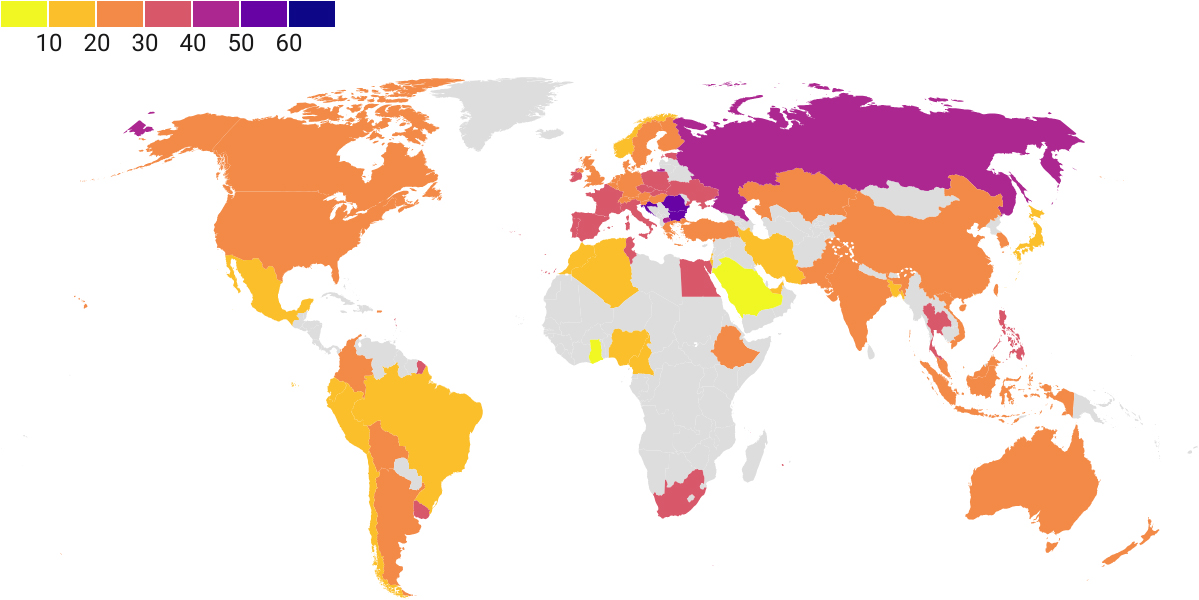
Figure 3. Female representation among publishing economists by country (in %). Published economists registered with the RePEc Author Service. A category is listed if it has at least 50 members. Overall, 16,660 of 63,833 economists are women.
Notes: Authors’ own calculations.
Source: RePEc Global data from 2022. Map created with Datawrapper.
Female representation among publishing economists by country (in %). Published economists registered with the RePEc Author Service. A category is listed if it has at least 50 members. Overall, 16,660 of 63,833 economists are women.
As for the developing countries covered, they perform similarly, if not worse. India and China have a female representation of 27%, while it is 16% for Brazil. Thailand positively stands out, with 39%. Meanwhile, in other countries, the lack of data signals the broader problem of the limited number of economists working and publishing at all. There are few such countries where the gender composition of economists is balanced; the best of these are Romania, Croatia, and Bulgaria, reaching 58%, 52%, and 51%, respectively. This presence is arguably not unique to economics, as these countries often outperform their European counterparts concerning the representation of women in the science, technology, engineering, and mathematics (STEM) fields. Some researchers associate this with their socialist past, particularly in the 1960s postwar educational reform. Both boys and girls were encouraged to participate in STEM (Campa & Serafinelli, 2019), and the socialist ideology placed women’s emancipation in the workplace as a core value (Vrabie, 2021). Beyond this historical past, current policy could work in women’s favor for the general population. In Bulgaria, for example, parents are eligible for childcare leave until their children reach age 12, a higher threshold than in many countries (Trumbic, Loayza, Ramalho, & Kraay, 2021). Such policies recognize that the gendered difference in unpaid care and domestic work—globally estimated at over two and a half hours a day (Hanna et al., 2023)—does not taper substantially with children’s age.
Status as a Magnifying Factor
Some researchers and institutions in economics are recognized to have great scientific legitimacy and exert influence over the field through their prestige and status: prize recipients, scientific societies, high-ranking schools, and journals. Substantial gender inequality is observed among these economic authorities. For instance, out of 90 recipients of the Nobel Memorial Prize in Economic Sciences, only 3 are women. Nevertheless, the Nobel Prize is often awarded for ideas developed a decade or two earlier, leaving room for change. Looking at another prize rewarding more contemporaneous contributions, the John Bates Clark Medal, the numbers are strikingly similar: three female laureates in its 70-year history (Cherrier & Svorencik, 2020).
Inequality is also visible in the top 20 articles published in the American Economic Review (AER) during its first 100 years (Arrow, Bernheim, Feldstein, McFadden, Poterba, & Solow, 2011). Those articles include only one female-authored paper, Anne Krueger’s “The Political Economy of the Rent-Seeking Society,” published in 1974. It is also the case that women are less likely to publish in top-ranked journals: On average, 8% of the authors of papers in top economic journals since 1950 were women (Hengel, 2022). Women also comprise a low share of decision-makers in these prestige processes, such as prize committees or editors. For instance, the committee selecting the top 20 articles of the AER was a male-only panel. Further, the Nobel Prize committees also show large gender imbalances, with an all-male panel in 2022 and one woman out of six jury members in 2023.
To investigate further gender inequality across economic authorities, we study the gender composition of the editorial boards of the journals referred to as the “Top Five”: the AER, Econometrica (ECA), Journal of Political Economy (JPE), Quarterly Journal of Economics (QJE), and Review of Economic Studies (ReStud). Editorial boards make decisions on the publication of research papers in their journals, and the Top Five exert significant influence over the field while advancing the career of published authors. We took names listed on each journal’s websites, either editors, coeditors, boards of editors, associated editors, or similar, and input them into NamSor, a name-checking artificial intelligence technology providing gender probability predictions.Table 1 shows the predicted gender composition of editorial boards per journal. The share of women editors varies between 22% of editors in QJE at the lower bound to 27% of editors in ReStud. Bransch and Kvasnicka (2022) find similar gender composition of editors for each Top Five journal. In addition, according to Funk, Iriberri, and Venus (2024), these numbers have risen steadily since 1960, in part due to an increased pool of qualified female economists, in part due to changes in preference for appointing women. Consistent with this, Card, DellaVigna, Funk, and Iriberri (2023) show that after the 2007 request by the National Academies to address the underrepresentation of women, female economists became more than three times as likely as men to be elected; this was not due to changes in the pipeline nor research productivity.
Presence of Female Economists as Editors at Top Five Journals
Scroll horizontally to view full table.
| Journal Title | Female Editors |
|---|---|
| American Economic Review | 26% |
| Econometrica | 24% |
| Journal of Political Economy | 24% |
| Quarterly Journal of Economics | 22% |
| Review of Economic Studies | 27% |
Notes: Authors’ own calculations from the journal’s web page conducted in 2023. For instance, in the case of the American Economic Review, its web page (https://www.aeaweb.org/journals/aer/about-aer/editors) stated N = 309 editors.
Does the Behavior of Women in Economics Differ from That of Men?
Differences in academic careers between men and women in economics could come from internal factors, revealed in behavioral differences and choices leading to different outcomes. The literature delving into these mechanisms focuses on two distinct areas. First, we explore how compliance with gender norms influences women’s decisions, mainly how they affect specialization, competitiveness, and family-life balance. Second, we explore differences in coauthorship choices between men and women economists.
Selection or Censorship Through Gender Norms
Gender norms, as detailed next, are accepted ideas of how men and women should be, and thus reflect dispositions of behaviors that are shaped by multiple factors such as culture or socialization. They are observed in two dimensions: horizontal differences, where women sort into different subfields or disciplines (Sierminska & Oaxaca, 2022); and vertical differences, where women economists’ access to more advanced roles is restricted.
One dimension of self-selection in economics can be observed while looking at the subfield choices across genders, which explains why missing women are more prevalent in specific areas of the discipline. Women in economics predominantly focus their research on applied subfields and examine individual behaviors, as noted by Lundberg and Stearns (2019). In particular, relative to the average share of women in economics, they are more present in subfields such as well-being and poverty, discrimination, and health (Beneito, Boscá, Ferri, & García, 2021). In contrast, the share of women in more theoretical or macroeconomic subfields is lower. Interestingly, part of this allocation across subfields tends to correspond to care specialization, a societal role more invested in by women according to gender norms. These gendered preferences extend beyond career choices to professional views: Surveying economists, May, McGarvey, and Whaples (2014) find systematic gender differences in views on labor market policies, including minimum wage and labor standards, as well as on equal opportunity in the economics profession itself.
Gendered preferences and interests over topics and method matter to women’s presence in economics. At the beginning of the pipeline, they can explain why the profession lacks women at the undergraduate level. In the United States, women tend to select less often into economics programs, not finding the discipline interesting or deterred by a misconception of it being about finance rather than development or education (Avilova & Goldin, 2024; Bayer & Rouse, 2016). At the end of the pipeline, gender subfield composition is associated with substantial differences in climate and career prospects. While claiming no causal effect, Fortin, Lemieux, and Rehavi (2021) highlight that subfields where women are underrepresented tend to be the ones in which a deterrent workplace climate is reported. Furthermore, they show that subfields with a higher proportion of women are described as having lower employment prospects, with fewer positions outside academia.
Gendered sorting across subfields also reflects a scientific construction of economics aligned with more masculine norms. Thirty years ago, Nelson (1995) noted that research questions, economic modeling, conceptual frameworks, and prevailing practices were deeply influenced by valorized traits associated with masculinity inherited from the 19th century. This orientation led, for example, to the dismissal of topics such as within-household dynamics or health care, to the conceptualization of economic agents as devoid of social or emotional ties, and to a disproportionate focus on competitive interactions. Interestingly, women tend to be sorted into subfields that diverge from these norms, placing greater emphasis on nonmarket activities or fields using more empirical, applied, and interdisciplinary approaches (Beneito et al., 2021). Gender norms may also contribute to the implicit hierarchy among subfields, translating into unequal career prospects. Finally, this construction of the discipline may push women out of economics altogether and constrain scientific progress. Nelson (1995) outlines two key areas in which progress is needed: first, on the framework, by moving away from asocialized economic agents in economic modeling; and second, on the methods, by paying more attention to data construction and replicability. Economics seems to have progressed in these directions during the last decades (Angrist & Pischke, 2010; Thaler, 2015).
Gendered differences in competition, particularly in academic careers displaying notable levels of competition, could drive women out of the field of economics if they tend to dislike such institutional functioning. The economics literature has well established that women tend to have a lower willingness to compete than men (Azmat, Calsamiglia, & Iriberri, 2016; Gneezy, Niederle, & Rustichini, 2003; Niederle & Vesterlund, 2007). This distaste for competition is magnified or softened by interacting gender norms: gender-neutral tasks (Günther, Ekinci, Schwieren, & Strobel, 2010), gender-stereotypical goods (Cassar & Zhang, 2022), evaluation of individual merit instead of comparison with peers (Gneezy et al., 2003), and performance rather than career-concerned incentives (Ytsma, 2025), all increase women’s performance under competition.
Research also identified a trend of self-censorship among women, which may be influenced by differing levels of self-esteem compared to men, as noted in studies that go beyond the scope of academia (Kling, Hyde, Showers, & Buswell, 1999). In the field of economics, this issue is particularly evident in the context of career advancement. A study by Bosquet, Combes, and García-Peñalosa (2019) on French academic economists sheds light on this phenomenon. It was observed that women are less likely to apply for promotions than their male counterparts. This reluctance could stem from various factors, including the perception of high entry requirements for promotion, a different valuation of the importance of promotions, and the anticipation of potential discrimination. We explore some of these factors in the next section.
Finally, the different allocation of time between professional life and family life for men and women is another gender norm that can limit women’s career progress in economics, as in the rest of the workforce. Recent evidence by Lassen and Ivandic (2024) documents a significant child penalty for women compared to men, with parenthood pushing them to leave their research positions or delaying tenure. The work-life balance challenge was particularly important during the COVID-19 pandemic, and this episode provided a natural environment to study how mothers and fathers allocated increased family time constraints. Several studies (Adams-Prassl, Boneva, Golin, & Rauh, 2022; Alon, Doepke, Olmstead-Rumsey, & Tertilt, 2020; Andrew et al., 2020) show that working mothers faced disproportionately increased childcare and homeschooling responsibilities due to lockdowns, with fewer tasks able to be done from home relative to men, which affected their professional activities. In economics, this is reflected by a larger gender gap in academic publishing during the pandemic (Andersen, Nielsen, Simone, Lewiss, & Jagsi, 2020; Gabster, van Daalen, Dhatt, & Barry, 2020).
However, the pandemic also brought about positive changes through this channel. The transition to digital seminars reduced travel barriers, increasing participation and visibility for female economists (Biermann, 2024). This shift resulted in a 7% increase in seminar invitations for women and a rise in representation among top-quartile female economists. The digital format’s benefits, particularly for women who faced challenges traveling medium distances, suggest that traditional seminar formats may have previously limited women’s participation in academic events.
These selection mechanisms help explain why recent progress has been so uneven across the ranking distribution. The increase at the top of the RePEc data is consistent with a highly selective process in which only a small subset of women remains in the profession long enough, and it complies with gender norms shaping the economics profession. Even if norms shifted in the past decades, cultural change is slow and path-dependent, limiting the number of women staying in the profession at the end of the pipeline.
Different Choices of Coauthors
The process of selecting coauthors in academic economics reveals notable gender-based differences. Boschini and Sjögren (2007) examine author teams’ formation and gender composition within three leading economics journals (AER, JPE, and QJE). Their findings indicate that these selections are not gender neutral. Women are more than twice as likely as men to collaborate with other women as coauthors. This might be a consequence of women receiving less credit toward tenure when their publications are with male coauthors or their advisors (Hussey, Murray, & Stock, 2022). In addition, the likelihood of women choosing female coauthors increases in subfields that have a higher proportion of women (Boschini & Sjögren, 2007). This finding suggests that some subfields of economics present better opportunities for women coauthorship selection than others. Furthermore, looking at faculty members across the top 96 U.S. economics departments, Ghosh and Liu (2020) find that female faculty are matched with coauthors of lower-ranked economics departments more often than male counterparts. This gender-biased collaboration significantly disadvantages female faculty at higher-ranked schools, resulting in fewer publications, citations, and probability of Top Five journal papers among them.
Another notable pattern in coauthorship related to gender is the tendency for women to collaborate in a more clustered manner. Ductor, Goyal, and Prummer (2021) reveal that women in economics engage in fewer collaborations overall and tend to work repeatedly with the same coauthors. This trend persists despite the increasing number of women entering the profession. Researchers find that these choices could generate gender differences, as they do not maximize career outcomes as much as coauthorship choices made by men. Regarding geographical ties over distance, Kwiek and Roszka (2021) study the coauthorship patterns of 25,000 Polish scientists across all disciplines and find substantial differences between the genders, as males exhibit a higher rate of international collaboration. Economics has the largest gender gap across all coauthoring types—men collaborate more than women. However, the international collaboration gap decreases as economists age. The underlying reasons for these distinct coauthorship patterns among women in economics are unclear and warrant further investigation. It is uncertain whether these patterns are caused by external barriers or self-selection. However, some insights are offered by studies like Ivanova-Stenzel and Kübler (2005), who find that women’s performance—here measured in terms of the completion of memory games—tends to be lower in mixed-gender teams.
The observed differences in women’s behaviors seem to partially explain the persistent gender gap in the field. More research is needed to understand how these behavioral differences interact with ranking, and whether these extend to women at the highest ranks of the profession. For instance, women who have achieved significant recognition, such as Nobel Prize laureates, often choose subfields traditionally perceived as more “feminine,” like development, labor, and environmental economics. This trend raises questions about whether these high-achieving women’s career paths and subfield choices reflect broader gender norms and self-selection patterns observed in the field. What does become apparent is that collaborating with such superstar prominent female economists provides a significant and large publication boost for junior women when contrasted to collaborating with male superstars (Tran, 2024). This difference is not found for junior men, which suggests that women who have reached the top of the profession can offer junior female economists a unique and gender-specific skill set beyond mere knowledge. Investigating these aspects further could provide deeper insights into the dynamics of gender disparity in economics, especially at the upper echelons of academic achievement.
Are Women Economists Treated Differently by the Profession?
Women in economics make different career choices than men, remaining on the academic track at lower rates at each career stage. Beyond behavioral differences, these decisions are made in a gender-biased work environment, which could explain career choices. Recent economic literature studies whether women face higher academic standards and receive less recognition for scientific contributions. Furthermore, some articles discuss the prevalence and consequences of hostile behavior. This strand of the literature highlights how a lower share of women in economics could be, in part, the product of higher costs and lower rewards in academic career paths for women.
Gender-Biased Evaluation Standards
Writing and publishing form the core of academic activity. Recent papers investigate whether women in economics face different standards in this process. With detailed submission and refereeing data from Energy Economics, Alexander, Gorelkina, and Hengel (2023) estimate that referees spend 4.4 more days reviewing female-authored papers and female authors spend 12.3 more days revising their manuscripts—a pattern driven mainly by referees with less experience reviewing female-authored papers than male-authored ones. Researchers interpret it as a sign of statistical discrimination by reviewers. Using citations as an indicator of research quality and a pool of publications in top economic journals, Card, DellaVigna, Funk, and Iriberri (2020) and Hengel and Moon (2023) find that female-authored submissions receive between 17 and 25 log points more citations compared to male-only authored articles. The researchers interpret these results as papers authored by women of higher quality, conditional on acceptance and held to higher standards. Along these lines, Hengel (2022) measures the quality of the writing of articles published in the top four economic journals (AER, ECA, JPE, and QJE) from 1950–2015, using text metrics that predict readability. She finds that the paper-writing quality of female authors is higher by 1%–6%, and the peer-review process magnifies this gap.
Seminars and conferences are also a large part of academic activity, where researchers display their scientific contributions, gather comments and constructive feedback, and meet with their peers. According to Doleac, Hengel, and Pancotti (2021), in economics seminars across 66 U.S. and non-U.S. departments, 23% of speakers were women. Two papers assess women’s access to research conferences. First, Hospido and Sanz (2021) estimates from submission data to European economic conferences that women are 6.8 percentage points less likely to be accepted than men. The authors find that this gap is larger for less-known scholars—again, women at the beginning of the pipeline are seeing the largest effects. The divergence is driven by male referees in fields with a higher share of men. In contrast, Chari and Goldsmith-Pinkham (2017) find that acceptance rates are indistinguishable by gender, using conference programs at the NBER Summer Institute from 2001–2016, except in the finance field. According to them, the lower representation of women is driven by lower submissions from female researchers and lower invitations from male organizers to participate compared to female organizers.
Further gender-biased evaluation standards are evidenced by Dupas et al. (2026), who collect data on all interactions between presenters and their audience for research seminars and summer conferences in the United States. They find that women receive more questions than men on average and the types of questions differ between genders, with questions for women more likely to be patronizing or hostile.Seré (2023) finds a similar result, showing that women are more interrupted in seminars than men are, based on YouTube recordings of seminars between 2020 and 2022. Interestingly, he provides evidence that this differential is driven by women in the audience, particularly with more junior female presenters receiving more interruptions.
Teaching often constitutes a large part of the professional activity of researchers.
Boring (2017) investigates if students might evaluate male and female teachers differently, controlling how well they learn from them. She uses student evaluation of teaching from a French university for courses where the teacher’s allocation is randomized and students take the same final exam. When controlling for teaching quality using grades, male students are more likely to give excellent grades to male instructors compared to female students and female instructors. Students also value more stereotypical gendered traits of teachers in detailed evaluations, associating male instructors with leadership and knowledgeability and female instructors with organizational skills. The author underlines that if teaching evaluations are used to evaluate the suitability of teachers for promotion, it could drive a gender bias against female instructors. The gender bias in teaching evaluation is also documented by Mengel, Sauermann, and Zölitz (2019) and strengthened by studies in other disciplines. However, a recent working paper from Andersson, Backman, Bengtsson, and Engström (2025) implements a double-blind, randomized field experiment in teaching evaluations and finds no evidence of gender bias. This paper implements the most robust methodology to investigate evaluation biases, but it constrains treatment to interactions between teaching mentors and undergraduate students through emails.
Lower Recognition
A potential channel for higher standards for women is the lack of recognition of women’s scientific contributions and abilities. Lack of recognition by the profession could limit women in their access to higher status and their influence over the field.
The lack of recognition for women in science throughout history is a documented phenomenon, named the “Matilda effect” by science historian Margaret Rossiter (1993). Based on observations of women’s career paths in sciences, she documents how their contributions tend to be attributed to male coauthors or recognized after long delay. The economic field is not exempt from such cases. Milton Friedman’s permanent income theory was elaborated in close collaboration with the empirical economists of consumption, Dorothy Brady, Rose Friedman, and Margaret Reid (Burns, 2022).
A strand of the recent literature on gender inequalities among economists explores whether contemporaneous scientific contributions of women also tend to be acknowledged less than those of men. Ross, Glennon, Murciano-Goroff, Berkes, Weinberg, and Lane (2022) use an extensive database on the composition of research teams linked to research grants on which data has been reported to the Institute for Research on Innovation and Science at the University of Michigan. Studies match research teams to research papers and patents produced. Women are 13% less likely to appear as coauthors on articles and 58% less likely to be named on patents, accounting for their job, the field, and the team. This gender gap increases with citations.
Even when women access authorship, recognition of scientific contribution could be valorized differently depending on the author’s gender. Sarsons, Gërxhani, Reuben, and Schram (2021) collect positions and publications for 613 academic economists at the top 35 U.S. schools and find that while solo authorship or coauthorship does not matter for men’s tenure prospects, tenure is less likely for women the more they coauthor—exhibiting biases in credit attribution for research work. Recognition also tends to be reflected in appropriate citations of published work. Koffi (2021) finds that articles published in the top journals by women tend to be less cited than men in the top journals (−10 log points with increasing differences as journal ranking increases). The study also finds women significantly cite women more—by 27 log points—perhaps a result of their smaller networks. Finally, relative to male and mixed authorships, there is suggestive evidence that female authors are cited more outside the economics discipline.
To understand whether this lack of recognition comes from a systematic different valuation of scientific abilities for men and women, two recent working papers explore a more subjective appreciation of women’s scientific abilities in reference letters. Eberhardt, Facchini, and Rueda (2023) and Baltrunaite, Casarico, and Rizzica (2025) analyze the texts of letters from the application packages, which present extensive descriptions of the abilities of young researchers. Both working papers argue that women tend to be depicted more in “grindstone” terms (hardworking) and men by “standout” terms (brilliant), a pattern driven mainly by male writers and referents supporting a smaller share of women. This pattern is similar to results from other disciplines (Schmader, Whitehead, & Wysocki, 2007). Baltrunaite et al. (2025) estimate that it can substantially affect later career paths: Gender differences in letters could explain 5%–8% of the future career success gap for women with a PhD.
This lack of recognition of women’s outstanding scientific abilities can be put into perspective with a more general stereotype of women lacking talent or brilliance: Academic fields in which the belief that raw, innate talent is, to a greater extent, more required for success than hard work and cooperation display a lower share of women (Leslie, Cimpian, Meyer, & Freeland, 2015). Napp and Breda (2022) conduct the first worldwide study of this stereotype’s prevalence among students, using a 2018 survey by the Programme for International Student Assessment (PISA). The researchers find that 15-year-old girls tend to attribute their failures to a lack of talent and a lack of outstanding qualities, more than boys of the same age, controlling students’ abilities in all countries.
Card et al. (2022) present evidence indicating a shift in the recognition of women at the upper echelons of the economics field. They collected data on active researchers, including their publications, curricula vitae, gender, and other career-related variables, as well as the probability of being selected as Econometric Society fellows from 1933 to 2019. The study reveals that, after accounting for career publications and citations, there was a significant negative impact on the chances of women being nominated and elected from 1933 to 1980. However, this trend reversed between 2000 and 2019, turning positive. The authors propose that this change could be due to voting economists attempting to rectify past underrepresentation of women, internalizing higher evaluation standards (as discussed in the previous subsection), or aiming to enhance women’s representation in the field. A large part of this gender premium in the latest decade also seems to correlate with policies implemented by the Nominating Committee of the Econometric Society. This recent premium documented for women at the very top of the profession aligns with our RePEc data as a sharp relative gain in the top 1%, but not as a flattening of the overall pyramid with midranked women seeing comparatively limited change over the same period.
Hostile Work Environment
A hostile work environment is a supplementary cost in academic careers that can drive women out of the profession. Analyzing hostile behavior is challenging, as these actions often occur in a more informal context and are hidden to avoid social and legal sanctions. Economics straddles the line between the humanities, focusing on human behavior, and the empirical rigor of pure sciences through its analytical methods. Uncovering the root causes of gender-based discrimination presents a challenge due to the inherent difficulty in establishing clear causation. The high value placed on causation within economics may have obscured the field’s recognition of discrimination issues compared to other social sciences.
The preliminary findings of Wu (2018) launched the discussion within the discipline on hostile behaviors, using data from an online forum used by PhD students to discuss the academic job market informally, on which young economists can express their true beliefs thanks to anonymity. She provides evidence that women tend to be depicted by more sexual and discriminating terms on this forum. Following up, Wu (2020) collects 2.2 million posts from the same forum and finds that posts discussing a female researcher contain 196% more nonprofessional terms than other posts. Threads discussing women also tend to deviate more from professional to personal topics and transition less back to professional matters than those discussing men. The author argues that deviation from professional topics on posts discussing women’s profiles could come from men’s desire to boost the positive perception of men as a social group from the profession, compared to more marginalized social groups like women.
The growing number of surveys has made discrimination more evident, and the accumulating evidence may be driving the increasing interest in research in this area. In a paper entitled “The Problem of Gender in Economics,” Kim (2023) surveys 20 female economists. The interviews underline the hostile climate and lack of support as key causes for the gender gap in presence. In particular, she argues that the marginalization of feminist and interdisciplinary work in economics likely limits the examination of gender-related hostility. The AEA Professional Climate Survey (American Economic Association, 2019) highlights gender differences in perception of the work environment, particularly regarding valuation from peers within the field, social inclusion, and discrimination. Overall, women declare themselves to be half as satisfied as men. An interesting variation is also provided by subfield: The fields with the lower prevalence of unwarranted advances are also those in which the share of women increased the most.
In 2018, the CSWEP dedicated its first newsletter to sexual harassment, sharing accounts from members of the profession and solutions and best practices (CSWEP, 2018). The prevalence of sexual harassment contributes to differentiating the experiences of men and women on the job, potentially driving women out of the field. Not limited to the academic context, Batut, Coly, and Schneider-Strawczynski (2022) provide empirical evidence that the most hostile workplaces in France saw the largest increase in women quitting their jobs after the 2017 MeToo movement. Using Swedish administrative data and vignette experiments, Folke and Rickne (2022) show that sexual harassment contributes to gender segregation of the labor market and the gender gap by driving women out of high-paying so-called masculine sectors and men out of lower-paying sectors that have a large share of women employees.
In the academic context, Deruelle (2022) conducts lengthy interviews on the role of sexuality in conferences with 24 researchers from the Centre National de la Recherche Scientifique (French National Centre for Scientific Research, or CNRS). The heterosexual men interviewed tend to describe conferences as spaces of freedom with personal and scientific opportunities. In contrast, their female colleagues find this permeability between work and nonwork detrimental, having to implement vigilant strategies to avoid the risk of sexual harassment and potentially missing career opportunities taking place at informal conference times. A recent working paper by Gertsberg (2025) underlines that exposing hostile behavior, particularly sexual harassment, can have unintended consequences. The author collects collaboration data for 83 junior female scholars from 58 U.S. universities before and after the 2017 MeToo movement. She observes that the women in her sample start 0.73 fewer new projects annually after 2017. This effect is mainly driven by collaboration with tenured male coauthors in universities with more ambiguous policies regarding sexual harassment. Gertsberg (2025) does not observe the same pattern for comparable junior male economists.
Paredes, Paserman, and Pino (2025) investigate the root causes of sexism in economics. They study two competing theories: a selection story, suggesting that the field attracts individuals with more traditional gender roles; and a treatment hypothesis, hinting at the economics perpetuating gender bias through its structure (i.e., limited female representation and market-oriented views). Surveying 3,700 Chilean university students across disciplines, the authors find that gender bias is greater in economics than in any other discipline, and both the selection and the treatment hypothesis seem to explain this gap. Indeed, before receiving any training in economics, future economics students are already more biased, but after one year of economic studies, the gender bias seems to increase. However, exposure to female instructors and peers can mitigate this bias, particularly for female students. The research suggests that introductory economics courses are critical in shaping attitudes. Increasing female faculty presence could reduce bias, perhaps because women are less gender-biased or the faculty act as role models. It also prompts further investigation into the selection effect of the discipline, moving toward eliminating gender discrimination.
Due at least in part to ethical considerations, studies investigating hostility have focused on the prevalence of victimization for women (or other groups) versus men, not on who exhibits this hostility and whether it interacts with the seniority of women. Goldsmith-Pickham, Ederer, and Jensen (2024) present one of the first attempts to do so: The authors assign publicly available Internet Protocol (IP) addresses to Econ Job Market Rumor (i.e., anonymous) users and gather a few characteristics, such as location and institution. They confirm the misogynistic content of this forum noted here and show that content is more likely to contain toxic, misogynistic, or hate speech than 70% of subreddits, which are noneconomic popular forums. They provide evidence that this type of content is generated by users across all types of economic institutions: 15% originate from university networks.
Is the Economic Job Market for Economists a Market Like Any Other?
Before examining the job market for economists, it is worth considering broader labor market dynamics, particularly those affecting female applicants, as they offer valuable parallels and lessons. While the job market for economists has unique characteristics, female economists encounter challenges similar to those of women in other labor markets, including discrimination and gender-based disparities.
Gender Gaps in the Labor Markets in General
Historically, the gender gap in labor force participation and earnings was attributed to women’s limited access to education and professional experience. However, since the 1980s, these factors have become less significant as an explanation. Instead, as Blau and Kahn (2017) notes, differential job sorting—both sectoral and occupational—now plays a more prominent role. This shift is mirrored in economics, where gender disparities persist across different ranks and subfields.
Bertrand (2018) identifies three key factors contributing to gender inequality in the broader labor market, which are also relevant to economics. First, educational choices and biases influence career trajectories. For example, gender biases in teacher evaluations can affect students’ field of study choices, affecting women’s participation in economics and their sorting into subfields. Second, psychological factors like attitudes toward risk and competition can affect occupational sorting and wage bargaining outcomes. Third, the unequal allocation of time between paid and unpaid work continues to affect women’s career progression. For example, the COVID-19 shock reveals differences in time allocation: Amano-Patiño, Faraglia, Giannitsarou, and Hasna (2020) highlight that it had unequal effects on researchers’ productivity. Women and midcareer researchers produced less new research (measured in terms of COVID-19-related working papers) relative to male and more senior researchers.
The job market for economists is not immune to these broader labor market trends. Gender bias in employer treatment and hiring processes, as discussed by Bertrand (2018) and Grosjean (2021), is likely a significant factor. In addition, because tasks differ in how much they count toward promotion, women often end up performing significantly more service than men (Babcock, Recalde, Vesterlund, & Weingart, 2017; Guarino & Borden, 2017). These studies are not specific to economics but use data from universities spanning multiple disciplines; nevertheless, they document that the gender gap in service persists within disciplines. One explanation for this disparity, put forward by Pyke (2011), is that women’s underrepresentation in academia creates structural pressure to accept service requests: Refusing would shift the burden to the few other women available, whereas male faculty face far less such pressure. Policies designed to reduce gender imbalances can inadvertently exacerbate these dynamics. Gender quotas in committees, for example, may increase the workload for female economists because of their limited representation in senior positions, as shown by Bagues, Sylos-Labini, and Zinovyeva (2017). This higher engagement in low-promotability tasks is likely to impede women’s career advancement. In addition, managing excessive service loads by extending work hours may lead to higher rates of stress and burnout (Babcock, Peyser, Vesterlund, & Weingart, 2022). In response, Babcock et al. (2022) created the “No Club,” a practical tool encouraging women to decline requests that pull them away from the work that matters most to their careers.
Unintended Consequences of the Economic Job Market
As explained by Chassonnery-Zaïgouche et al. (2025), economists are both experiencing and studying the job market, leading them to interpret discrimination mainly through an economic lens. Since the 1970s, the lower status of women in economics has mostly been discussed as an allocation problem—attempting to optimize the limited number of collective female economists rather than what is a challenging individual experience. In this context, the proposed solutions to fight discrimination were centered on reducing market imperfections, such as increasing transparency during the hiring process by clearly stating job requirements and publicly circulating job openings. Fourcade, Ollion, and Algan (2015) note a strong consensus in economics on quality criteria, such as the hierarchy of journals and institutions, which is less pronounced in other social sciences. This consensus facilitates the job market’s functioning but may have unintended consequences for female candidates. The assumption that information about candidates, typically obtained from reference letters by prominent scholars or publication records, is uniformly reliable overlooks the potential for gender bias. As discussed previously, such bias can hinder female scholars’ recognition and fair evaluation, thereby perpetuating gender disparities in the field.
In the U.S. context, a plausible reason for the observed leaky pipeline is the tenure track: a fixed probationary period at the end of which assistant professors are evaluated for tenure. Tenure tracks often coincide with the start of a family. This decision has strong and long-lasting effects on worker productivity, mainly because the first years of a researcher’s career are often characterized by a steep increase in productivity and a large accumulation of human capital. Most U.S. universities have implemented family-friendly policies such as the tenure clock stop. Nevertheless, these do not always prove effective and might even disadvantage mothers. Antecol, Bedard, and Stearns (2018) used data from 50 top economics departments in the United States between 1980 and 2005. They found that the gender-neutral tenure clock stop—a policy where parents are allowed to extend the tenure probation period for one year per newborn for up to two children—markedly increased tenure rates for men as they decreased those for women. Their results highlighted that gender-neutral tenure clock-stop policies allowed fathers to improve their productivity disproportionately, measured in terms of papers in top journals. The primary reason for the productivity loss being larger for women on average than for men is the higher costs of childbearing that they bear. Quantifying this productivity loss, Kim and Moser (2025) found in science that only 27% of mothers who are academic scientists achieved tenure, compared to 48% of fathers and 46% of women without children. This cost, combined with long publication lags in economics, means the extra year available from the tenure clock stopping disproportionately benefited men, who can expect lower productivity loss. It provides these individuals more time for papers to get published in the more stringent Top Five journals, and in response to this, some change publication strategies early in their career, focusing on harder-to-publish journals (Antecol et al., 2018).
On the other hand, in Europe, tenure-clock arrangements are far from uniform. In some institutions, clock stops are tied specifically to mothers rather than being available to all parents. More evidence is needed to compare these models, especially since gender-neutral policies were partly adopted in response to women’s low take-up of existing tenure clock-stop provisions in the United States. This case study calls attention to a better understanding of the impact of such policies at critical stages of women’s careers. Furthermore, it highlights the need to design gender-neutral policies carefully, ensuring that they do not reinforce exclusion mechanisms due to gender norms, such as by accounting for differential time allocation inside the household, as discussed in Section 3.
Policy Recommendations to Promote Gender Balance
Considering the empirical and theoretical literature presented here, several policy recommendations become apparent. The following subsections propose some of these evidence-based recommendations in three distinctive areas—networks and women’s organizations; mentoring, role models, and representation; and further solutions looking at information and incentives.
Networks and Women’s Organizations
In the 21st century, women’s networks have emerged in various sectors. We focus here on networks for women in economics and discuss how these organizations can be a powerful tool to promote gender equality.
The CSWEP was founded in 1971 in the United States to survey women’s progress and promote their careers. As shared by Berland, Harman, and Moreau-Kastler (2023), the early days of the network witnessed a controversy between Carolyn Bell, the inaugural chairperson of the committee, and Milton Friedman after the latter refused an invitation to participate in a panel to comment on the first CSWEP report findings. Friedman said that he worried that the committee’s actions would result in preferential treatment and distort the market. This dispute highlights the strength of the debate on the existence of discrimination against minority groups and its measures. CSWEP sought to improve the condition of women in the profession, and yet it worked within mainstream economic frameworks—framing gender disparities as labor market imperfections requiring better information rather than structural critiques (Chassonnery-Zaïgouche et al., 2025). More broadly, Allied Social Science Associations meetings discussing gender in economics from the 1970s to the late 1980s did not include sessions on feminism at all, and only a few on women in the profession. CSWEP focused on gender parity and the economic job market for men and women, while other associated groups went on to criticize the current economic system itself. As a result, many felt that CSWEP was not feminist enough (Espinel & Betancourt, 2022). Despite this reluctance, CSWEP thrived. Every year, it surveys the economic profession to increase the visibility of women in economics and issues recommendations to change practices and foster gender balance in the discipline. Its success has encouraged professionals to create other women in economics networks, inside and outside the United States, in academia and public institutions. These organizations have emerged at the institutional and regional levels, becoming increasingly numerous and visible. Following keyword analysis through online search and checking on X (formerly Twitter), we now count at least 30 of these networks globally.
The Australian Women in Economics Network is a striking example of the positive impact that networks can have on women’s careers. After its creation in 2017, Cassells, Risse, Wood, and Yengin (2022) observed two substantial changes. First, there appears to be a steady increase in the inclusion of women in economics, as measured in the number of women who are members of the Economic Society of Australia every year. Second, there is a sharp improvement in women’s representation, as measured by the share of women being award nominees, recipients, and keynote speakers. To the best of our knowledge, the impact of academic networks for women on research collaborations has yet to be evaluated.
Mentoring, Role Models, and Representation
Mentoring is often suggested to incentivize young female scholars to stay in gender-imbalanced fields and help them in their career paths. Increasingly, recent work has evaluated the success of mentoring programs. The CSWEP CeMENT program, consisting of mentoring workshops held along AEA annual meetings, was designed as a randomized treatment. Blau, Currie, Croson, and Ginther (2010) and a follow-up study by Ginther, Currie, Blau, and Croson (2020) estimate that the program increased by 11 percentage points the probability of having a tenure-stream job and by 9 percentage points in the top 50 institutions. Pretenure grants and publications have also increased. The results are telling, as these workshops consisted of short-term treatments. Long-term mentoring also seems to matter for orientation and career choice. Canaan and Mouganie (2021) find that having a science advisor who is a woman increases the likelihood that undergraduate students will major in science. Yet, as noted by Buckles (2019), it is difficult to tell whether the difference comes from reduced information asymmetry, support for younger professionals, or the provision of role models, or even a combination of these things. Suppose we believe that mentoring provides young female scholars with crucial knowledge and training. In that case, we need to understand why those women lack this knowledge compared to their male counterparts in the first place, as well as what specific knowledge female advisors provide.
Beyond mentoring, the provision of role models also appears to influence course and career choices positively.Porter and Serra (2020) demonstrate that brief exposure to female role models who majored in economics at the same university increases the likelihood of women choosing that major as well. In STEM fields, Breda, Grenet, Monnet, and Van Effenterre (2023) found that a one-hour intervention by women working in STEM fields encourages high-achieving girls to pursue science specializations. They note that the key to successful intervention is altering students’ perceptions of science fields without overly emphasizing existing gender inequalities. Agurto, Bazan, Hari, and Sarangi (2023) find similar results from a 20-minute interaction in Peru, with changes in preferences driven by increased self-confidence after exposure to role models. Similarly, Di (2024) discusses the role of aspiration, reporting that in China, while high-achieving role models improve low-performing girls’ academic outcomes, they can negatively affect mental health, as the group’s elevated aspirations are not always met.
Evidence from 1999 to 2013 from Wellesley College, a women’s liberal arts college, shows that of all the admitted applicants, those who eventually do enroll at the college are 94% more likely to receive an economics degree than nonenrollees who eventually study elsewhere.
In college, students benefit from more women as classroom peers, alumnae networks providing access to female role models, and greater exposure to female instructors. The college’s gender exposure explains half the difference in the resultant degree, with nongender-related variables explaining much less of the difference (Butcher, McEwan, & Weerapana, 2024). This is also the case with Avilova and Goldin (2023), who show that a light-touch, early-intervention program can effectively increase the fraction of female undergraduates majoring in economics relative to men. The intervention, taking place at 20 U.S. colleges and universities, included providing better information about application to economics and exposing students to role models. Furthermore, specific instructional course content and presentation style were updated. The effect was driven by smaller liberal arts colleges, with large universities showing only moderate success—potentially due to the light-touch nature of intervention not having enough scale.
Providing role models is thus a relatively low-cost policy that is particularly effective when qualified women are available for such examples. Enhancing the presence of women in top positions is expected to motivate more young women to enter such fields. However, caution is warranted. First, the descriptive RePEc evidence suggests that while such high-status female role models are becoming more visible, and thus elite role models are increasingly available, they remain numerically scarce relative to the broader pool of women in the profession, meaning that their ability to transform the pipeline on their own may be limited. Second, as highlighted in the seminal work of Ellemers, Van den Heuvel, De Gilder, Maass, and Bonvini (2004) and its follow-up by Faniko, Ellemers, and Derks (2021), successful women in male-dominated environments may sometimes conform to and reinforce masculine norms, a phenomenon known as the “Queen Bee phenomenon (Fariko et al., p. 383).” Using surveys among senior academics on their views regarding their young colleagues, the authors show that senior women often undervalue the career commitment of female PhD candidates, a pattern not observed among their male counterparts. Derks, Van Laar, and Ellemers (2016) note that women in masculine environments often present themselves in a masculine manner, distance themselves from junior women, and legitimize gender hierarchies. These strategies, they argue, are adopted as coping mechanisms in male-dominated work environments. Such behaviors can render these women less effective as mentors and role models. To mitigate this, Derks et al. (2016) recommend that women provide positive individual feedback to colleagues, dissociating from the attached social identity and reducing the legitimacy of gender hierarchies, encouraging senior women to support their younger female colleagues more effectively.
Further Solutions
Information can be a powerful tool in reducing gender bias. Research indicates that providing details about specific discriminatory behaviors and their historical prevalence can prove effective. For instance, a study at a French university by Boring and Philippe (2021) revealed a gender gap of 0.19 points in student evaluations that favored male teachers. The authors then run a trial in which they provide information to some students about how students typically discriminate. Looking at the next evaluation, they show that providing detailed information reduced the gender gap in evaluations by half.
The use of precise information, in addition to stopping discriminatory action, can encourage change. For example, Bedard, Dodd and Lundberg (2021) show that positive feedback, specifically personalized letters praising high-achieving undergraduate female students, have affirming consequences. These letters increase the probability of students seeking more information and entering or continuing the study of economics by between 5% and 6%. Similarly, the public disclosure of a large male bias in grant allocation in Sweden prompted procedural reforms that improved allocative efficiency and influenced wider institutional change (Hensvik & Nilsson, 2025).
The infrastructure and institutional frameworks within the economics profession play a crucial role in mitigating barriers for women. Initiatives like the AEA’s guidelines for the job market’s hiring process, including campaigns against holding interviews in hotel rooms (Chassonnery-Zaïgouche et al., 2025) and where appropriate, mechanisms for candidates to indicate membership in underrepresented groups (Cawley, 2019), are steps toward changing the professional environment. A wider part of this is AEA’s Professional Code of Conduct—adopted in 2018—highlighting individual and collective responsibility to create a professional environment with equal opportunity and fair treatment. Institutional commitments to diversity can also shift behavior: Following the European Central Bank’s 2010 public pledge to diversity, its gender promotion gap disappeared, driven primarily by increased applications from women who had previously self-selected out due to lower preferences for competition (Hospido, Laeven, & Lamo, 2022).
Beyond general codes and guidelines, specific soft infrastructures can address key barriers and reduce inequality. Verbal or codified agreements between audience members and speakers to minimize participants’ gender-related interruptions might create a more balanced workshop environment. Seré (2023) shows that having a female chair at seminars does not necessarily reduce interruptions from women, but it does significantly decrease interruptions by men, thereby mitigating the gender bias evidenced in Dupas et al. (2026).
The role of certification and accreditation at the departmental level is also significant. The Athena SWAN Charter, a framework supporting gender equality in higher education, has been particularly effective. Institutions implementing this charter have seen a halving of the gender pay gap at the professorial level, driven by an increase in the relative pay of more senior women professors (Gamage, Sevilla, & Smith, 2021). Six economics departments in the United Kingdom are Athena Swan award holders: Birkbeck, East Anglia, Edinburgh, Oxford, St Andrews, and York.
Quota systems, while controversial, have shown positive outcomes in specific contexts. De Sousa and Niederle (2022) use the advantages of the chess competition context to precisely measure the performances of players in a highly male-dominated area (10% female players). In this setting, a quota requiring one woman on each team led to an increase in both the number and quality of female players without adversely affecting male performance. However, quotas in decision-making, such as in scientific committees, do not necessarily lead to better outcomes for women. Bagues et al. (2017) find that male evaluators in mixed-gender committees tend to give lower evaluations to female candidates, expecting that they could be favored by female evaluators. In addition, as previously discussed, quotas can inadvertently increase the burden of low-promotability tasks on women.
Finally, incentives can align economists’ preferences. De Sousa and Niederle (2022) outline how quotas could be combined with incentive systems. They suggest focusing on output-based incentives, such as rewarding departments for the research output of female faculty (measured by publications, citations, and prizes) rather than merely counting the number of female faculty members. This approach aims to discourage the assignment of nonpromotable tasks to women, as highlighted by Babcock et al. (2017), and addresses some issues associated with pure representation quotas. In addition, they recommend ranking departments based on female faculty achievements and offering incentives like reduced conference or library subscription fees to those meeting certain thresholds. Further, as discussed previously, travel distances between home and the host institution seem to matter, as when invited to speak at seminars, women travel less than men. Identifying what barriers restrict these opportunities—whether childcare costs or household norms—is essential, as these soft incentives affect the time allocation of women and men differently. Similarly, considering the distance traveled, whether this necessitates overnight stays and how this interacts with the speaker’s gender is a recommended area of inquiry. Finally, as discussed in section 3, designing different competitive mechanisms can shift women’s attitudes toward competition. For example, if “winner takes all,” where there is only one winner, then existing gender biases may be amplified. A reframing of academic awards where rather than winner takes all, it becomes “shared success,” where everyone who reaches a defined threshold of merit receives the award, could alter male and female performance. This could be a consideration for competitions around fellowships and grant awards, but the approach merits further research in academic settings.
Conclusion
This review and outline of progress highlights persisting gender inequalities in economics. Despite a decrease over time, differences are observed along several dimensions, such as time, space, status, and recognition. We show that over the past 10 years, the reduction in inequalities has concentrated among top scholars, with gains in publication ranking most proportionally increasing for scholars in the top 1%, while gender parity among lower-ranked economists has advanced more slowly. This suggests that the current pyramid structure visible across women in economics is shifting slowly toward a more balanced structure. Progress at the top could indicate a concentration of policy efforts in part of the field with the most prevalent inequalities. Viewed through the lens of the leaky pipeline, this reduction in loss may also show a catch-up effect, as women who persisted through earlier career stages now reach the end of the pipeline at the top of the distribution.
In contrast, barriers to women in economics persist overall. These systemic barriers could correspond with the limited reduction of inequalities at the bottom of the pyramid, with less than one-third of new PhDs granted to female economists and fewer still reaching the top half of the publication ranking. The pattern indicates that the beginning of the pipeline is still to be consolidated.
Reviewing the recent literature, we detail barriers and gender differences that the discipline has identified as sources of inequalities. We show that women in economics—through self-selection or gender norms—make different choices and demonstrate different behaviors when it comes to career development. These choices put them on specific trajectories or result in them leaving academia at rates and levels different from their male counterparts. We then discuss papers exploring whether the academic field of economics treats women and men differently. Women face lower rewards and higher costs of pursuing careers because of differences in evaluation standards, lower recognition, and hostility in the workplace. Turning to the labor market in economics, we highlight that women face similar discrimination mechanisms as they do in other labor markets. We show that these mechanisms combine with norms specific to economics, resulting in gender differential placement in the job market. Finally, we review policies promoting gender balance, highlighting the crucial role of organizations and infrastructures.
This review provides a framework to better understand gender inequalities within economics.
While recent research has begun to chart this space, more evidence is required to understand better the obstacles that women researchers face in this field, and how these differ by level of seniority. In particular, understanding how behavioral differences and gender-biased environments interact would be of interest: What share of behavioral differences between men and women is explained by women who adapt to hostility or higher standards—and how does this change with experience? Following Card et al. (2022), understanding whether inequalities are mainly due to women leaving at different stages of the pipeline or getting stuck at the bottom of the pyramid could point to different policy tools. Finally, we think that exploring what networks and mentoring bring to junior women in economics could be valuable, especially if this allows women to access skills beneficial to pursuing a career in economics.
Appendix
A. RePEc Data
The RePEc Author Service (https://ideas.repec.org/archives.html) is a decentralized bibliographic database of over 3.8 million research items including working papers, journal articles, books, book chapters, and software components. In total, of these published articles, gender is attributed to authors through pattern matching with NamSor, a name checker for gender, origin, and ethnicity. Data is available for the full time period and disaggregated over the last 10 years since records began in 1973.
RePEc data measures representation in economics by publication ranking. The RePEc Global data is available at https://ideas.repec.org/top/female.html#cohort. It is worth stating that the registered authors can be economists outside academic institutions. Representation is measured across countries (attribution is based on affiliations) and genders (attribution is performed by analyzing first names and a list of exceptions). Representation is also measured by the ranking of authors, which combines the depth and breadth of research.
B. CSWEP Data
CSWEP data was gleaned manually from annual reports for the period of 1973–2022. Data was unavailable for the years 1976, 1986, 1987, and 1991 due to the different focuses of the CSWEP report, and 1980 is excluded due to different sampling. The CSWEP reports can be found at https://www.aeaweb.org/about-aea/committees/cswep/about/survey/annual-reports.
C. Women’s Presence in Economics Studies
Women’s Presence in Economics Studies data was gleaned from various sources, mostly national analysis, provided here with detail, citation, and year of study.
Reported Share of Women in Economics Across Studies
Scroll horizontally to view full table.
| Share | Sample | Region | Source |
|---|---|---|---|
| Undergraduates | |||
| 43% | All students | France | Boring and Zignago (2018) |
| 32% | All students | United Kingdom | Costa-Dias et al. (2023) |
| 34% | All students | United States | CSWEP (2021) |
| Masters | |||
| 51% | All students | France | Boring and Zignago (2018) |
| 51% | All students | United Kingdom | Costa-Dias et al. (2023) |
| Doctorates | |||
| 35% | Awarded doctorates | France | Sagot (2023) |
| 40% | Awarded doctorates | United Kingdom | Costa-Dias et al. (2023) |
| 34% | Awarded doctorates | United States | Wessel (2021) |
| Assistant Professors | |||
| 43% | All of France | France | Boring and Zignago (2018) |
| 33% | Departments with doctoral programs | United States | CSWEP (2021) |
| 37% | All economics departments | United Kingdom | Costa-Dias et al. (2023) |
| 37% | Top 238 universities | Global | Auriol et al. (2022) |
| Associate and Full Professors | |||
| 24% | Full professors | France | Boring and Zignago (2018) |
| 26% | Readers (associate professors) | United Kingdom | Costa-Dias et al. (2023) |
| 18% | Professors | United Kingdom | Costa-Dias et al. (2023) |
| 27% | Departments with doctoral programs—associate professors | United States | CSWEP (2021) |
| 18% | Departments with doctoral programs—full professors | United States | CSWEP (2021) |
| 25% | Top 238 universities—associate and full professors | Global | Auriol et al. (2022) |
| Other | |||
| 26% | Published economists | Global | RePEc (2022) |
Notes: Differences in numbers might reflect differences in the definition of economic institutions. The choice of the studies reflects data availability.
References
- Adams-Prassl, A., Boneva, T., Golin, M., & Rauh, C. (2022). Work that can be done from home: Evidence on variation within and across occupations and industries. Labour Economics, 74.
- Agurto, M., Bazan, M., Hari, S., & Sarangi, S. (2026). To inspire and to inform: The role of role models. World Bank Economic Review, March. https://doi.org/10.1093/wber/lhag005.
- Ahmed, R., Nasir, R., & Sharma, N. (2021). Diversifying economics: Resources for Black and other underrepresented minorities. International Growth Centre.
- Alexander, D., Gorelkina, O., & Hengel, E. (2023). Gender and the time cost of peer review. Discussion paper, Tinbergen Institute.
- Allgood, S., Walstad, W. B., & Siegfried, J. J. (2015). Research on teaching economics to undergraduates. Journal of Economic Literature, 53(2), 285–325.
- Alon, T., Doepke, M., Olmstead-Rumsey, J., & Tertilt, M. (2020). The impact of COVID-19 on gender equality. Covid Economics: Vetted and Real-Time Papers. CEPR Press.
- Amano-Patiño, N., Faraglia, E. Giannitsarou, C., & Hasna, Z. (2020). The unequal effects of Covid-19 on economists’ research productivity. Faculty of Economics, University of Cambridge Working Paper Series.
- American Economic Association. (2019). AEA Professional Climate Survey: Final report. American Economic Association Report.
- Andersen, J. P., Nielsen, M. W., Simone, N., Lewiss, R., & Jagsi, R. (2020). COVID-19 medical papers have fewer women first authors than expected. eLife, June 15.
- Andersson, O., Backman, M., Bengtsson, N., & Engström, P. (2025). Are economics students biased against female teachers? Evidence from a randomized, double-blind natural field experiment. Journal of Economic Behavior & Organization, 238, 107153.
- Andrew, A., Cattan, S., Costa Dias, M., Farquharson, C., Kraftman, L., Krutikova, S., Phimister, A., & Sevilla, A. (2020). Inequalities in children’s experiences of home learning during the COVID-19 lockdown in England. Fiscal Studies, 41(3), 653–683.
- Angrist, J. D., & Pischke, J.-S. (2010). The credibility revolution in empirical economics: How better research design is taking the con out of econometrics. Journal of Economic Perspectives, 24(2), 3–30.
- Antecol, H., Bedard, K., & Stearns, J. (2018). Equal but inequitable: Who benefits from gender-neutral tenure clock stopping policies? American Economic Review, 108(9), 2420–2041.
- Arrow, K. J., Bernheim, B. D., Feldstein, M. S., McFadden, D. L., Poterba, J. M., & Solow, R. M. (2011). 100 years of the American Economic Review: The top 20 articles. American Economic Review, 101(1), 1–8.
- Auriol, E., Friebel, G., Weinberger, A., & Wilhelm, S. (2022). Underrepresentation of women in the economics profession more pronounced in the United States compared to heterogeneous Europe. Proceedings of the National Academy of Sciences, 119(16).
- Avilova, T., & Goldin, C. (2023). What did UWE do for economics? National Bureau of Economic Research (NBER), Cambridge, MA.
- Avilova, T., & Goldin, C. (2024). Seeking the “missing women” of economics with the undergraduate women in economics challenge. Journal of Economic Perspectives, 38(3), 137–162.
- Azmat, G., Calsamiglia, C., & Iriberri, N. (2016). Gender differences in response to big stakes. Journal of the European Economic Association, 14(6), 1372–1400.
- Babcock, L., Peyser, B., Vesterlund, L., & Weingart, L. (2022). The No Club: Putting a stop to women’s dead-end work. Simon and Schuster.
- Babcock, L., Recalde, M. P., Vesterlund, L., & Weingart, L. (2017). Gender differences in accepting and receiving requests for tasks with low promotability. American Economic Review, 107(3), 714–747.
- Bagues, M., Sylos-Labini, M., & Zinovyeva, N. (2017). Does the gender composition of scientific committees matter? American Economic Review, 107(4), 1207–1238.
- Baltrunaite, A., Casarico, A., & Rizzica, L. (2025). Women in economics: The role of gendered references at entry in the profession. European Economic Review, 105155.
- Bateman, V., Kankanam Gamage, D., Hengel, E., & Liu, X. (2021). The gender imbalance in UK economics. Royal Economic Society, Silver Anniversary Women’s Committee Report.
- Batut, C., Coly, C., & Schneider-Strawczynski, S. (2022). It’s a man’s world: Culture of abuse, #MeToo and worker flows. University of Bocconi working paper.
- Bayer, A., & Rouse, C. E. (2016). Diversity in the economics profession: A new attack on an old problem. Journal of Economic Perspectives, 30(4), 221–242.
- Bedard, K., Dodd, J., & Lundberg, S. (2021). Can positive feedback encourage female and minority undergraduates into economics? AEA Papers and Proceedings, 111, 128–132.
- Beneito, P., Boscá, J. E., Ferri, J., & García, M. (2021). Gender imbalance across subfields in economics: When does it start? Journal of Human Capital, 15(3), 469–511.
- Berland, O., Harman, O., & Moreau-Kastler, N. (2023). Pipelines or pyramids: A review of barriers for women in economics. IGC Working Paper.
- Bertrand, M. (2018). Coase Lecture—the glass ceiling. Economica, 85(338), 205–231.
- Besley, T., Folke, O., Persson, T., & Rickne, J. (2017). Gender quotas and the crisis of the mediocre man: Theory and evidence from Sweden. American Economic Review, 107(8), 2204–2242.
- Biermann, M. (2024). Remote talks: Changes to economics seminars during Covid-19. European Economic Review, 163.
- Blau, F. D., & Kahn, L. M. (2017). The gender wage gap: Extent, trends, and explanations. Journal of Economic Literature, 55(3), 789–865.
- Blau, F. D., Currie, J. M., Croson, R. T. A., & Ginther, D. K. (2010). Can mentoring help female assistant professors? Interim results from a randomized trial. American Economic Review, 100(2), 348–52.
- Boring, A. (2017). Gender biases in student evaluations of teaching. Journal of Public Economics, 2017, 145, 27–41.
- Boring, A., & Philippe, A. (2021). Reducing discrimination in the field: Evidence from an awareness raising intervention targeting gender biases in student evaluations of teaching. Journal of Public Economics, 193, 104323.
- Boring, A., & Zignago, S. (2018). Economics: Where are the women? Banque de France.
- Boschini, A., & Sjögren, A. (2007). Is team formation gender neutral? Evidence from coauthorship patterns. Journal of Labor Economics, 25(2), 325–365.
- Bosquet, C., Combes, P.-P., & García-Peñalosa, C. (2019). Gender and promotions: Evidence from academic economists in France. Scandinavian Journal of Economics, 121(3), 1020–1053.
- Bothwell, E., Roser-Chinchilla, J., Deraze, E., Ellis, R., Galán-Muros, V., Gallegos, G., Mutize, T., & UNESCO International Institute for Higher Education in Latin America and the Caribbean, and Times Higher Education. (2022). Gender equality: How global universities are performing. UNESCO International Institute for Higher Education in Latin America and the Caribbean.
- Boustan, L., & Langan, A. (2019). Variation in women’s success Across PhD programs in economics. Journal of Economic Perspectives, 33(1), 23–42.
- Bransch, F., & Kvasnicka, M. (2022). Male gatekeepers: Gender bias in the publishing process? Journal of Economic Behavior & Organization, 202, 714–732.
- Breda, T., Grenet, J., Monnet, M., & Van Effenterre, C. (2023). How effective are female role models in steering girls towards STEM? Evidence from French high schools. Economic Journal, 133(633), 1773–1809.
- Buckles, K. (2019). Fixing the leaky pipeline: Strategies for making economics work for women at every stage. Journal of Economic Perspectives, 33(1), 43–60.
- Burns, J. (2022). Hidden figures: A new history of the permanent income hypothesis. History of Political Economy, 54(S1), 43–68.
- Butcher, K. F., McEwan, P., & Weerapana, A. (2024). Women’s colleges and economics major choice: Evidence from Wellesley College applicants. Feminist Economics, 123–161. https://doi.org/10.1080/13545701.2024.2334886
- Campa, P., & Serafinelli, M. (2019). Politico-economic regimes and attitudes: Female workers under state socialism. Review of Economics and Statistics, 101(2), 233–248.
- Canaan, S., & Mouganie, P. (2021). The impact of advisor gender on female students’ STEM enrollment and persistence. Journal of Human Resources, 0320–10796R2.
- Card, D., DellaVigna, S., Funk, P., & Iriberri, N. (2020). Are referees and editors in economics gender neutral? Quarterly Journal of Economics, 135(1), 269–327.
- Card, D., DellaVigna, S., Funk, P., & Iriberri, N. (2022). Gender differences in peer recognition by economists. Econometrica, 90(5), 1937–1971.
- Card, D., DellaVigna, S., Funk, P., & Iriberri, N. (2023). Gender gaps at the academies. Proceedings of the National Academy of Sciences, 120(4), e2212421120.
- Cassar, A., & Zhang, Y. J. (2022). The competitive woman: Evolutionary insights and cross-cultural evidence into finding the Femina Economica. Journal of Economic Behavior & Organization, 197, 447–471.
- Cassells, R., Risse, L., Wood, D., & Yengin, D. (2022). Lifting diversity and inclusion in economics: How the Australian Women in Economics Network put the evidence into action. Economic Papers: A Journal of Applied Economics and Policy. https://doi.org/10.1111/1759-3441.12367
- Cawley, J. (2019). A guide and advice for economists on the U.S. junior academic job market, 2018–2019 edition. American Economic Association.
- Chari, A., & Goldsmith-Pinkham, P. (2017). Gender representation in economics across topics and time: Evidence from the NBER Summer Institute. National Bureau of Economic Research (NBER), Cambridge, MA.
- Chassonnery-Zaïgouche, C., Cherrier, B., & Singleton, J. D. (2025). Economics Is Not a Man’s Field”: CSWEP and the First Gender Reckoning in Economics, 1971–1991. History of Political Economy, 57(4), 641–675.
- Cherrier, B., & Svorencik, A. (2020). Defining excellence: Seventy years of the John Bates Clark Medal. Journal of the History of Economic Thought, 42(2), 153–176.
- Committee on the Status of Women in the Economics Profession (CSWEP) (2018). CSWEP News—First Issue. https://www.aeaweb.org/content/file?id=6388
- Committee on the Status of Women in the Economics Profession (CSWEP) and American Economics Association (AEA) (2021). Committee on the Status of Women in the Economics Profession (CSWEP) annual survey of U.S. economics departments, United States, 1994–2020. https://doi.org/10.3886/ICPSR37118.v5
- Costa-Dias, M., Hengel, E., Jones, M., & Neves, H. (2023). Women in academic economics. Royal Economic Society.
- Derks, B., Van Laar, C., & Ellemers, N. (2016). The Queen Bee phenomenon: Why women leaders distance themselves from junior women. Leadership Quarterly, 27(3), 456–469.
- Deruelle, F. (2022). La sexualité en colloque, une “parenthèse enchantée”? Terrains Travaux, 40(1), 89–111.
- De Sousa, J., & Niederle, M. (2022). Trickle-down effects of affirmative action: A case study in France. National Bureau of Economic Research (NBER), Cambridge, MA.
- Di, A. (2024). Inspirational or demotivational: Experimental evidence on the impacts of role models. SSRN, 10.2139/ssrn.4749305
- Doleac, J. L., Hengel, E., & Pancotti, E. (2021). Diversity in economics seminars: Who gives invited talks? xAEA Papers and Proceedings, 111, 55–59.
- Ductor, L., Goyal, S., & Prummer, A. (2021). Gender and collaboration. Review of Economics and Statistics, 1–40.
- Dupas, P., Handlan, A., Sasser Modestino, A., Niederle, M., Seré, M., Sheng, H., Wolfers, J., & Seminar Dynamics Collective. (2026). Gender differences in economics seminars. American Economic Review, 116(2), 749–789.
- Eberhardt, M., Facchini, G., & Rueda, V. (2023). Gender differences in reference letters: Evidence from the economics job market. Economic Journal, 133(655), 2676–2708.
- Ellemers, N., Van den Heuvel, H., De Gilder, D., Maass, A., & Bonvini, A. (2004). The underrepresentation of women in science: Differential commitment or the Queen Bee syndrome? British Journal of Social Psychology, 43(3), 315–338.
- Espinel, C., & Betancourt, R. (2022). A history of the institutionalization of feminist economics through its tensions and founders. History of Political Economy, 54.
- Faniko, K., Ellemers, N., & Derks, B. (2021). The Queen Bee phenomenon in academia 15 years after: Does it still exist, and if so, why? British Journal of Social Psychology, 60(2), 383–399.
- Folke, O., & Rickne, J. (2022). Sexual harassment and gender inequality in the labor market. Quarterly Journal of Economics, 137(4), 2163–2212.
- Formella, C., Grund, M. M., Hanspach, P., Martin, N., Meys, N., Molitor, P., Posada, C., Schmitjans, J., Sengupta, S., & Uhl, M. (2020). The Women in Economics Index 2020. Women in Economics Initiative.
- Fortin, N., Lemieux, T., & Rehavi, M. (2021). Gender differences in fields of specialization and placement outcomes among PhDs in economics. AEA Papers and Proceedings, 111, 74–79.
- Fourcade, M., Ollion, E., & Algan, Y. (2015). The superiority of economists. Journal of Economic Perspectives, 2015, 29, 89–114.
- Funk, P., Iriberri, N., & Venus, N. (2024). Women in editorial boards: An investigation of female representation in top economic journals. CEPR Discussion Papers.
- Gabster, B. P., van Daalen, K., Dhatt, R., & Barry, M. (2020). Challenges for the female academic during the COVID-19 pandemic. The Lancet, 395(10242), 1968–1970.
- Gamage, D. K., Sevilla, A., & Smith, S. (2021). Women in economics: A UK perspective. Oxford Review of Economic Policy, 36(4), 962–982.
- Gertsberg, M. (2025). The unintended consequences of# MeToo—evidence from research collaborations. Journal of Finance, November 19.
- Ghosh, P., & Liu, Z. (2020). Coauthorship and the gender gap in top economics journal publications. Applied Economics Letters, 27(7), 580–590.
- Ginther, D. K., Currie, J. M., Blau, F. D., & Croson, R. T. A. (2020). Can mentoring help female assistant professors in economics? An evaluation by randomized trial. AEA Papers and Proceedings, 110, 205–209.
- Ginther, D. K., Kahn, S., & Milakhina, D. (2025). Same as it ever was: Gender, race, and ethnicity differences in promotion for academic economists. AEA Papers and Proceedings, 115, 195–201.
- Gneezy, U., Niederle, M., & Rustichini, A. (2003). Performance in competitive environments: Gender differences. Quarterly Journal of Economics, 118(3), 1049–1074.
- Goldsmith-Pickham, P., Ederer, F., & Jensen, K. (2024). Anonymity and identity online. Brookings. https://doi.org/10.48550/arXiv.2409.15948
- Gregory-Smith, I. (2018). Positive action towards gender equality: Evidence from the Athena SWAN Charter in UK medical schools. British Journal of Industrial Relations, 56(3), 463–483.
- Grosjean, P. (2021). Patriarcapitalisme: En finir avec les inégalités femmes/hommes dans l’économie. Seuil.
- Guarino, C. M., & Borden, V. M. H. (2017). Faculty service loads and gender: Are women taking care of the academic family? Research in Higher Education, 58(6), 672–694.
- Günther, C., Ekinci, N. A., Schwieren, C., & Strobel, M. (2010). Women can’t jump? An experiment on competitive attitudes and stereotype threat. Journal of Economic Behavior & Organization, 75(3), 395–401.
- Hanna, T., Meisel, C., Mayer, J., Azcona, G., Bhatt, A., & Duerta Valero, S. (2023). Forecasting time spent in unpaid care and domestic work. Frederick S. Pardee Center for Environmental Futures, Josef Korbel School of International Studies, University of Denver. https://www.unwomen.org/sites/default/files/2023-10/technical-brief-forecasting-time-spent-in-unpaid-care-and-domestic-work-en.pdf
- Hengel, E. (2022). Publishing while female: Are women held to higher standards? Evidence from peer review. Economic Journal, 132(648), 2951–2991.
- Hengel, E., & Moon, E. (2023). Gender and equality at top economics journals. University of Liverpool working papers.
- Hensvik, L., & Nilsson, J. (2025). Equality for granted: What happens when discrimination in academia becomes salient? CEPR Press.
- Hospido, L., & Sanz, C. (2021). Gender gaps in the evaluation of research: Evidence from submissions to economics conferences. Oxford Bulletin of Economics and Statistics, 83(3), 590–618.
- Hospido, L., Laeven, L., & Lamo, A. (2022). The gender promotion gap: Evidence from central banking. Review of Economics and Statistics, 104(5), 981–996.
- Hussey, A., Murray, S., & Stock, W. (2022). Gender, coauthorship, and academic outcomes in economics. Economic Inquiry, 60(2), 465–484.
- Ivanova-Stenzel, R., & Kübler, D. (2005). Courtesy and idleness: Gender differences in team work and team competition. IZA discussion paper.
- Kim, M. (2023). The problem of gender in economics. Review of Radical Political Economics, 55(4), https://doi.org/10.1177/04866134231199127
- Kim, S. D., & Moser, P. (2025). Women in science: Lessons from the baby boom. Econometrica, 93(September), 1521–1560.
- Kleemans, M., & Thornton, R. (2023). Fully promoted: The distribution and determinants of full professorship in the economics profession. AEA Papers and Proceedings, 113, 467–72.
- Kling, K. C., Shibley Hyde, J., Showers, C. J., & Buswell, B. N. (1999). Gender differences in self-esteem: A meta-analysis. Psychological Bulletin, 125(4), 470.
- Koffi, M. (2021). Gendered citations at top economic journals. AEA Papers and Proceedings, 111, 60–64.
- Kwiek, M., & Roszka, W. (2021). Gender disparities in international research collaboration: A study of 25,000 university professors. Journal of Economic Surveys, 35(5), 1344–1380.
- Lassen, A.-S., & Ivandic, R. (2024). Parenthood and academic career trajectories. AEA Papers and Proceedings, 114(May), 238–242.
- Leslie, S.-J., Cimpian, A., Meyer, M., & Freeland, E. (2015). Expectations of brilliance underlie gender distributions across academic disciplines. Science, 347(6219), 262–265.
- Liborio, J., & Sharma, N. (2021). Matter of pride: Engendering LGBTQ+ inclusivity in thought and research. International Growth Centre.
- Lundberg, S., & Stearns, J. (2019). Women in economics: Stalled progress. Journal of Economic Perspectives, 33(1), 3–22.
- May, A. M., McGarvey, M., & Whaples, R. (2014). Are disagreements among male and female economists marginal at best? A survey of AEA members and their views on economics and economic policy. Contemporary Economic Policy, 32(1), 111–132.
- Mengel, F., Sauermann, J., & Zölitz, U. (2019). Gender bias in teaching evaluations. Journal of the European Economic Association, 17(2), 535–566.
- Morgan, A. C., LaBerge, N., Larremore, D. B., Galesic, M., Brand, J. E., & Clauset, A. (2022). Socioeconomic roots of academic faculty. Nature Human Behaviour, 6(12), 1625–1633.
- Napp, C., & Breda, T. (2022). The stereotype that girls lack talent: A worldwide investigation. Science Advances, 8(10).
- Nelson, J. A. (1995). Feminism and economics. Journal of Economic Perspectives, 9(2), 131–148.
- Niederle, M., & Vesterlund, L. (2007). Do women shy away from competition? Do men compete too much? Quarterly Journal of Economics, 122(3), 1067–1101.
- Olivetti, C., & Petrongolo, B. (2016). The evolution of gender gaps in industrialized countries. Annual Review of Economics, 8, 405–434.
- Paredes, V., Paserman, M. D., & Pino, F. J. (2025). Does economics make you sexist? Review of Economics and Statistics, 1–47.
- Périvier, H. (2020). L’économie féministe. Presses de Sciences Po.
- Porter, C., & Serra, D. (2020). Gender differences in the choice of major: The importance of female role models. American Economic Journal: Applied Economics, 12(3), 226–254.
- Pyke, K. (2011). Service and gender inequity among faculty. (2011). PS: Political Science & Politics, 44(1), 85–87.
- Research Papers in Economics (RePEc). (2022). Female representation in economics. Online dataset. https://ideas.repec.org/top/female.html
- Ross, M. B., Glennon, B. M., Murciano-Goroff, R., Berkes, E. G., Weinberg, B. A., & Lane, J. I. (2022). Women are credited less in science than men. Nature, 608(7921), 135–145.
- Rossiter, M. W. (1993). The Matthew Matilda effect in science. Social Studies of Science, 23(2), 325–341.
- Sagot, G. (2023). Le genre, caractère structurant du champ de la recherche et de l’enseignement supérieur en economie? Doctoral thesis, Ecole Polytechnique.
- Sarsons, H., Gërxhani, K., Reuben, E., & Schram, A. (2021). Gender differences in recognition for group work. Journal of Political Economy, 129(1), 101–147.
- Schmader, T., Whitehead, J., & Wysocki, V. H. (2007). A Linguistic Comparison of letters of recommendation for male and female chemistry and biochemistry job applicants. Sex Roles, 57(7), 509–514.
- Seré, M. (2023). Don’t stop me now: Gender attitudes in academic seminars through machine learning. University of Antwerp working paper.
- Sharma, N. (2020). Economics’ racial reckoning: A discipline that studies inequality confronts its own. International Growth Centre.
- Sierminska, E., & Oaxaca, R. L. (2022). Gender differences in economics PhD field specializations with correlated choices. Labour Economics, 79.
- Thaler, R. H. (2015). Misbehaving: The making of behavioral economics. W. W. Norton & Company.
- Tran, S. (2024). Star secrets? Gender differences in the impact of superstar coauthorship in economics. SSRN, https://www.shantran.com/ShannonTran_JobMarketPaper.pdf
- Trumbic, T., Loayza, N. V., Ramalho, R., & Kraay, A. C. (2021). Women, business, and the law. World Bank.
- Vrabie, E. (2021). How come Bulgaria and Romania lead “Women in Tech” rankings? The Recursive.
- Wessel, D. (2021). Who earned PhDs in economics in 2020? Brookings, December 28. https://www.brookings.edu/articles/who-earned-phds-in-economics-in-2020/
- Wu, A. H. (2018). Gendered language on the Economics Job Market Rumors forum. AEA Papers and Proceedings, 108, 175–79.
- Wu, A. H. (2020). Gender bias among professionals: An identity-based interpretation. Review of Economics and Statistics, 102(5), 867–880.
- Ytsma, E. (2025). Lone stars or constellations? The impact of performance pay on the distribution of academics. Working paper. https://gitlab.com/eytsma/research_papers/raw/master/LoneStarsOrConstellations_ErinaYtsma_MIT_latest.pdf
- Zimmermann, C. (2013). Academic rankings with RePEc. Econometrics and Multidisciplinary Digital Publishing Institute. https://www.econstor.eu/bitstream/10419/103628/1/77752757X.pdf
Figures
Figure 1. Share of women along the pipeline in the United States, the United Kingdom, and France. In each panel, the bars (in purple) represent the average share of women observed by degree or position type.
Notes: Authors’ own calculations.
Sources: For France: Boring and Zignago (2018) and Sagot (2023); for the United States: CSWEP (2021) and Wessel (2021); for the United Kingdom: Costa-Dias et al. (2023). For more details, see Table A-1 in the Appendix.
Share of women along the pipeline in the United States, the United Kingdom, and France. In each panel, the bars (in purple) represent the average share of women observed by degree or position type.
Figure 2. Evolution of the share of women over time by publication ranking and seniority level. (a) Proportion of women in groups by ranking in publication by RePEc; (b) proportion of women in groups by presence in university positions by CSWEP.
Notes: Authors’ own calculations. In each panel, the first bars (in purple) represent the average share of women observed between 1973 and 2022. The yellow bars represent the average share of women observed between 2012 and 2022. The higher numbers represented by the yellow bars highlight progress at a faster pace in the last decade relative to the previous 40 years. For instance, between the full period (1973–2022) and the last 10 years (2012–2022), female economists in the top 1% representation rises by 108% (5.2 percentage points). The remaining 49% rises by 8% (1.8 percentage points). The RePEc dataset provides a percentile breakdown only from the 1st to the 50th percentile of the distribution.
Sources: (a) RePEc global data; (b) CSWEP Annual Reports. Detailed information on data collection can be found in Appendix A.
Evolution of the share of women over time by publication ranking and seniority level. (a) Proportion of women in groups by ranking in publication by RePEc; (b) proportion of women in groups by presence in university positions by CSWEP.
Figure 3. Female representation among publishing economists by country (in %). Published economists registered with the RePEc Author Service. A category is listed if it has at least 50 members. Overall, 16,660 of 63,833 economists are women.
Notes: Authors’ own calculations.
Source: RePEc Global data from 2022. Map created with Datawrapper.
Female representation among publishing economists by country (in %). Published economists registered with the RePEc Author Service. A category is listed if it has at least 50 members. Overall, 16,660 of 63,833 economists are women.
Tables
Presence of Female Economists as Editors at Top Five Journals
Scroll horizontally to view full table.
| Journal Title | Female Editors |
|---|---|
| American Economic Review | 26% |
| Econometrica | 24% |
| Journal of Political Economy | 24% |
| Quarterly Journal of Economics | 22% |
| Review of Economic Studies | 27% |
Notes: Authors’ own calculations from the journal’s web page conducted in 2023. For instance, in the case of the American Economic Review, its web page (https://www.aeaweb.org/journals/aer/about-aer/editors) stated N = 309 editors.
Reported Share of Women in Economics Across Studies
Scroll horizontally to view full table.
| Share | Sample | Region | Source |
|---|---|---|---|
| Undergraduates | |||
| 43% | All students | France | Boring and Zignago (2018) |
| 32% | All students | United Kingdom | Costa-Dias et al. (2023) |
| 34% | All students | United States | CSWEP (2021) |
| Masters | |||
| 51% | All students | France | Boring and Zignago (2018) |
| 51% | All students | United Kingdom | Costa-Dias et al. (2023) |
| Doctorates | |||
| 35% | Awarded doctorates | France | Sagot (2023) |
| 40% | Awarded doctorates | United Kingdom | Costa-Dias et al. (2023) |
| 34% | Awarded doctorates | United States | Wessel (2021) |
| Assistant Professors | |||
| 43% | All of France | France | Boring and Zignago (2018) |
| 33% | Departments with doctoral programs | United States | CSWEP (2021) |
| 37% | All economics departments | United Kingdom | Costa-Dias et al. (2023) |
| 37% | Top 238 universities | Global | Auriol et al. (2022) |
| Associate and Full Professors | |||
| 24% | Full professors | France | Boring and Zignago (2018) |
| 26% | Readers (associate professors) | United Kingdom | Costa-Dias et al. (2023) |
| 18% | Professors | United Kingdom | Costa-Dias et al. (2023) |
| 27% | Departments with doctoral programs—associate professors | United States | CSWEP (2021) |
| 18% | Departments with doctoral programs—full professors | United States | CSWEP (2021) |
| 25% | Top 238 universities—associate and full professors | Global | Auriol et al. (2022) |
| Other | |||
| 26% | Published economists | Global | RePEc (2022) |
Notes: Differences in numbers might reflect differences in the definition of economic institutions. The choice of the studies reflects data availability.